



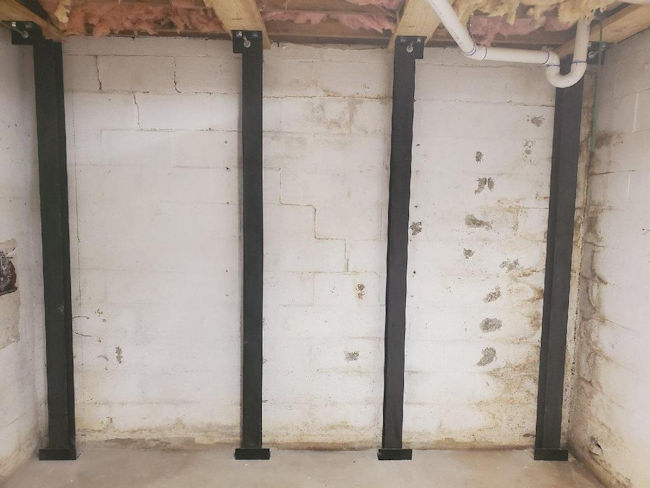
Steel Force Beam Basement Wall Repair (Wall Bracing)
When a basement wall needs to be stabilized and exterior access is limited, or a fast timeline matters, steel force beams offer an engineered solution that can be installed quickly with immediate stabilization.
Force beams are not the right answer for every bowing wall. We’ll be direct about when they fit and when they don’t. In the right conditions, they’re a proven, cost-effective way to stop further wall movement.
We use wide flange steel I-beams for force beam installations, with beam count and spacing determined by the wall’s height, backfill height, and lateral load requirements.

When Force Beams Are The Right Choice
Since force beams are installed entirely from the interior, they have no yard clearance requirement.
When Force Beams Are NOT The Right Choice
get a free quote
How Steel Force Beams Work
A force beam is a vertical steel I-beam (W4x13) installed against the interior face of a bowing wall, running from the base of the wall to the floor system above. It works by bracing the wall against further inward movement.
Base connection (anchored at the slab)
The beam is anchored to the concrete floor at the base of the wall, creating a fixed lower connection point that resists inward pressure.
Top connection (active force)
The top connection attaches into the floor framing/structure above and includes a calibrated spring mechanism carrying roughly 1,000 pounds of preloaded force, so it is not passive. The spring applies consistent outward pressure from day one.
Can force beams improve the wall position over time?
Yes, sometimes. The spring mechanism can be adjusted periodically. As soil conditions allow, this may gradually work the wall back toward plumb over months/seasons. It’s slow and not guaranteed, but it’s possible in a way that purely passive bracing systems are not.
The Honest Trade-Off: Effective, but Visible
Force beams work and they’re permanent. But they’re also visually obvious. A vertical row of steel I-beams along the wall projects into the basement space.
Best fit spaces:
- unfinished basements
- utility/mechanical rooms
- storage areas where function matters more than aesthetics
If the basement is finished living space and appearance is a priority, other solutions (anchors/tiebacks/carbon fiber) may be a better fit.
Force Beams vs Other Bowing Wall Repair Options
Steel Force Beam Repair FAQs
When bowing is more significant, when correction is a major goal, or when soil-engaging resistance is required.
Usually not, because they are visually obvious and project into the space.
Yes. They are designed as a permanent stabilization system.
No. One major advantage is no exterior access requirement.
Their primary job is stabilization. Gradual improvement may be possible through adjustment over time, but full correction isn’t guaranteed.